
Encumbrance? Is it necessary?
Encumbrance on Property: What Is It and Is It Necessary to Check Before Buying?
Introduction
Buying a property is one of the most significant financial decisions that an individual or family makes during their lifetime. Whether you are purchasing a residential plot, a house, an apartment, or commercial property, ensuring that the title is legally clear is just as important as negotiating the purchase price. Many buyers focus on location, price, amenities, and future appreciation but often overlook one of the most critical legal aspects of property ownership—encumbrance.
An encumbrance can directly affect your ownership rights, your ability to obtain a bank loan, and even your right to sell the property in the future. Purchasing a property without verifying its encumbrance status can expose a buyer to serious legal and financial risks. Therefore, understanding what an encumbrance is and why it matters is essential before entering into any property transaction.
This article explains the concept of encumbrance, the importance of an Encumbrance Certificate (EC), how to obtain one, its limitations, and why every property buyer should insist on verifying it before making an investment.
What Is an Encumbrance?
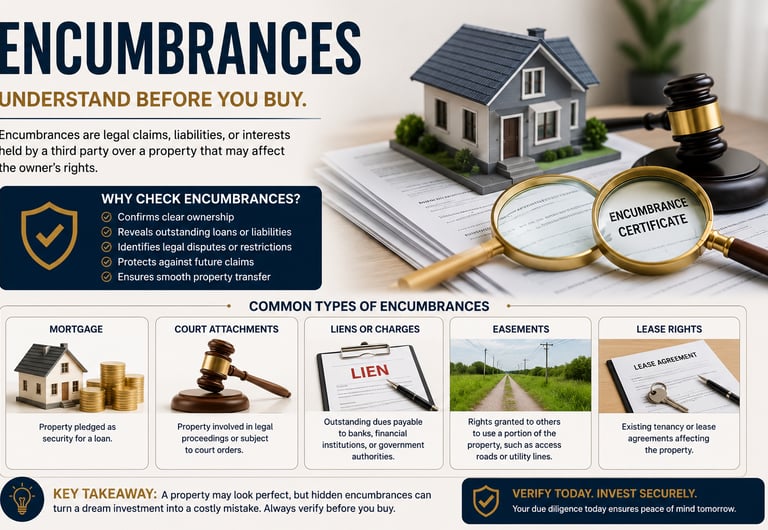
In legal terminology, an encumbrance refers to any legal claim, liability, charge, restriction, or interest created over a property that may affect the owner's rights or limit the transfer of ownership. An encumbrance does not necessarily mean that the property is under dispute; however, it indicates that another person or institution may have a legal interest in the property.
For example, if a property owner has mortgaged the property to a bank to obtain a loan, the bank acquires a legal interest over that property until the loan is fully repaid. Similarly, if there is a court attachment, lease, easement, or registered agreement affecting the property, these may also constitute encumbrances.
Simply put, an encumbered property is one that carries legal obligations or third-party rights which may influence the purchaser's ownership.
What Is an Encumbrance Certificate (EC)?
An Encumbrance Certificate (EC) is an official document issued by the office of the Sub-Registrar that records registered transactions affecting a property during a specified period. The certificate provides details of registered sale deeds, gift deeds, partition deeds, mortgages, releases, leases, and other registered instruments concerning the property.
If no registered transaction affecting the property exists during the requested period, a Nil Encumbrance Certificate may be issued, indicating that no registered encumbrance has been found for that period.
Banks, financial institutions, advocates, and prudent purchasers rely upon the EC as an important component of legal due diligence before approving loans or completing property transactions.
Why Is Checking Encumbrance Necessary?
Verifying encumbrance before purchasing property is not merely a formality—it is one of the most important steps in property due diligence. A buyer who neglects this verification may unknowingly purchase property that is already mortgaged, attached by a court, or subject to another person's legal rights.
An encumbrance search helps confirm whether the seller has clear authority to transfer the property. It reduces the possibility of future litigation, protects the purchaser from hidden liabilities, and provides greater confidence that the investment is legally secure.
Banks also insist upon an Encumbrance Certificate before sanctioning home loans because they need assurance that the property offered as security does not already carry conflicting registered charges.
Types of Encumbrances
Encumbrances can arise in several different forms depending on the nature of the legal interest created over the property.
A mortgage is one of the most common encumbrances, where the property is pledged to a bank or financial institution as security for a loan. Until the loan is discharged, the lender retains certain legal rights over the property.
A lease may also constitute an encumbrance because the tenant acquires legal rights to occupy the property during the lease period. A purchaser buying such property may have to honour the existing lease.
A court attachment occurs when a court restrains the transfer of property in connection with pending litigation or recovery proceedings. Such attachments may significantly affect the marketability of the property.
Certain easement rights, such as rights of passage, drainage, or utility access enjoyed by neighbouring properties, may also affect ownership and use of the land.
Registered agreements to sell, settlement deeds, partition deeds, gift deeds, and family arrangements may also create legal interests that appear in the encumbrance records.
What Information Does an EC Contain?
An Encumbrance Certificate generally contains details such as the description of the property, survey number, location, names of executants and claimants, nature of registered transactions, document numbers, dates of registration, and the period covered by the search.
These details enable prospective purchasers and legal professionals to verify the chain of ownership and identify whether any registered encumbrances exist during the selected period.
What an Encumbrance Certificate Does Not Reveal
Although an Encumbrance Certificate is an extremely valuable legal document, it is not conclusive proof of a clear title.
The EC generally records only registered transactions. Certain important matters may not appear in the certificate, such as unregistered agreements, equitable mortgages created by deposit of title deeds (depending on local practice and applicable law), pending civil suits that have not resulted in registered orders, acquisition proceedings, revenue disputes, tenancy claims not reflected in registration records, inheritance issues, or possession disputes.
Therefore, relying solely on an EC without conducting comprehensive legal due diligence can be risky.
Importance of Comprehensive Title Verification
A prudent property purchaser should never depend exclusively upon the Encumbrance Certificate. Instead, the EC should form one component of a broader legal verification process.
A comprehensive title verification generally includes examining previous title deeds, revenue records, mutation entries, land tax receipts, municipal records, approved building plans, possession status, court litigation searches, land classification, government acquisition notifications, and physical inspection of the property.
An experienced property lawyer carefully analyses all these documents before certifying that the title is marketable and legally transferable.
How to Obtain an Encumbrance Certificate
Obtaining an Encumbrance Certificate is relatively straightforward. The applicant submits an application before the jurisdictional Sub-Registrar's Office containing the property details and the period for which the search is required. After payment of the prescribed fee, the registration records are searched and the certificate is issued if the records are available.
Many States have also introduced online facilities that allow applicants to apply for and download ECs electronically, making the process faster and more transparent.
Why Banks Insist on an EC
Whenever a borrower applies for a home loan or loan against property, banks conduct extensive legal due diligence before sanctioning finance. One of the key documents examined during this process is the Encumbrance Certificate.
Banks need to ensure that the property offered as security is not already subject to conflicting registered mortgages or legal claims that could jeopardize their security interest. A clear EC enhances the lender's confidence and facilitates smoother loan processing.
Common Mistakes Made by Property Buyers
Many buyers unknowingly expose themselves to legal risks by neglecting proper verification. Some rely solely on the seller's assurances without independently verifying the property records. Others examine only the latest sale deed and ignore earlier title documents. Some purchasers obtain an EC for only a few recent years instead of examining a sufficiently long period that reflects the property's ownership history.
Another common mistake is assuming that a Nil Encumbrance Certificate guarantees absolute ownership. While a Nil EC indicates the absence of registered transactions during the search period, it does not eliminate the possibility of unregistered claims or other legal complications.
Benefits of Verifying Encumbrance Before Purchase
Conducting an encumbrance search provides several practical benefits. It helps identify registered mortgages and legal claims, confirms whether the seller has a transferable interest, reduces the possibility of future litigation, supports bank loan approvals, enhances buyer confidence, and protects the investment from hidden legal complications.
Most importantly, proper verification allows buyers to make informed decisions before committing substantial financial resources.
How Daftese Consulting Pvt. Ltd. Can Help
Property documentation involves much more than preparing sale deeds. At Daftese Consulting Pvt. Ltd., we assist clients with complete property due diligence before purchase. Our services include title verification, Encumbrance Certificate assistance, legal document examination, ownership history analysis, mutation verification, property documentation, registration support, and comprehensive legal health reports.
Our experienced professionals work to ensure that clients understand the legal status of the property before investing, thereby minimizing risks and safeguarding their interests. We believe that informed buyers make secure investments.
Conclusion
An Encumbrance Certificate is one of the most important documents in any property transaction, but it should never be viewed in isolation. It provides valuable information regarding registered transactions affecting a property and plays a crucial role in determining whether the property is free from registered legal claims. However, because certain legal issues may not appear in the EC, purchasers should always undertake comprehensive title verification before completing any transaction.
Buying property is not merely about acquiring land or a building—it is about acquiring lawful ownership free from hidden liabilities. Careful verification today can prevent years of litigation tomorrow. Before investing your hard-earned money, ensure that the property's legal history has been thoroughly examined by experienced professionals.
Contact
Helping you navigate real estate with confidence
Phone
daftese@gmail.com
+91- 6002804744
© 2025. All rights reserved.